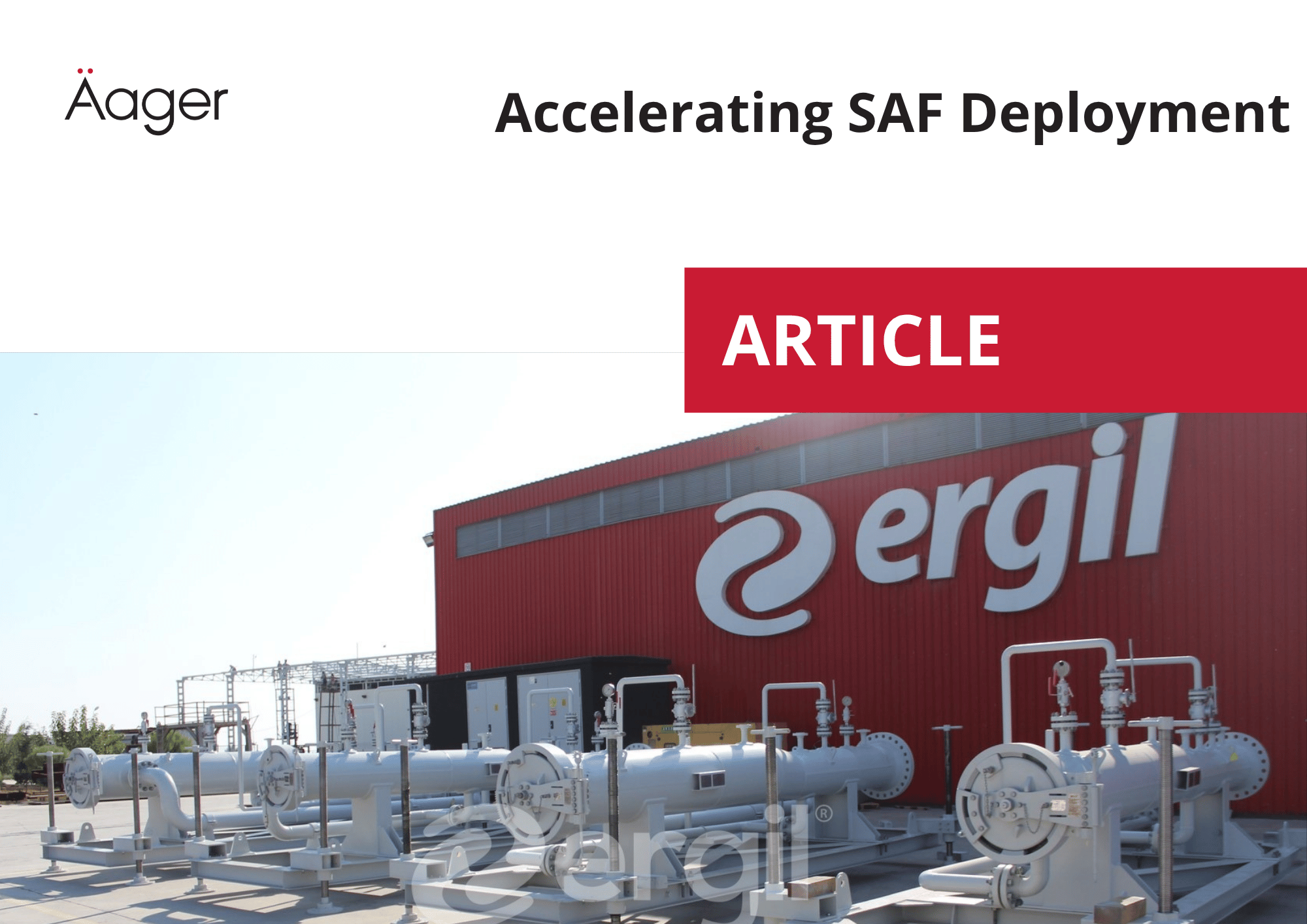
ERGIL Technical Article · Sustainable Aviation Fuel
Accelerating SAF Deployment
Modular Process Equipment & Fabricated Systems that De-risk Sustainable Aviation Fuel Projects
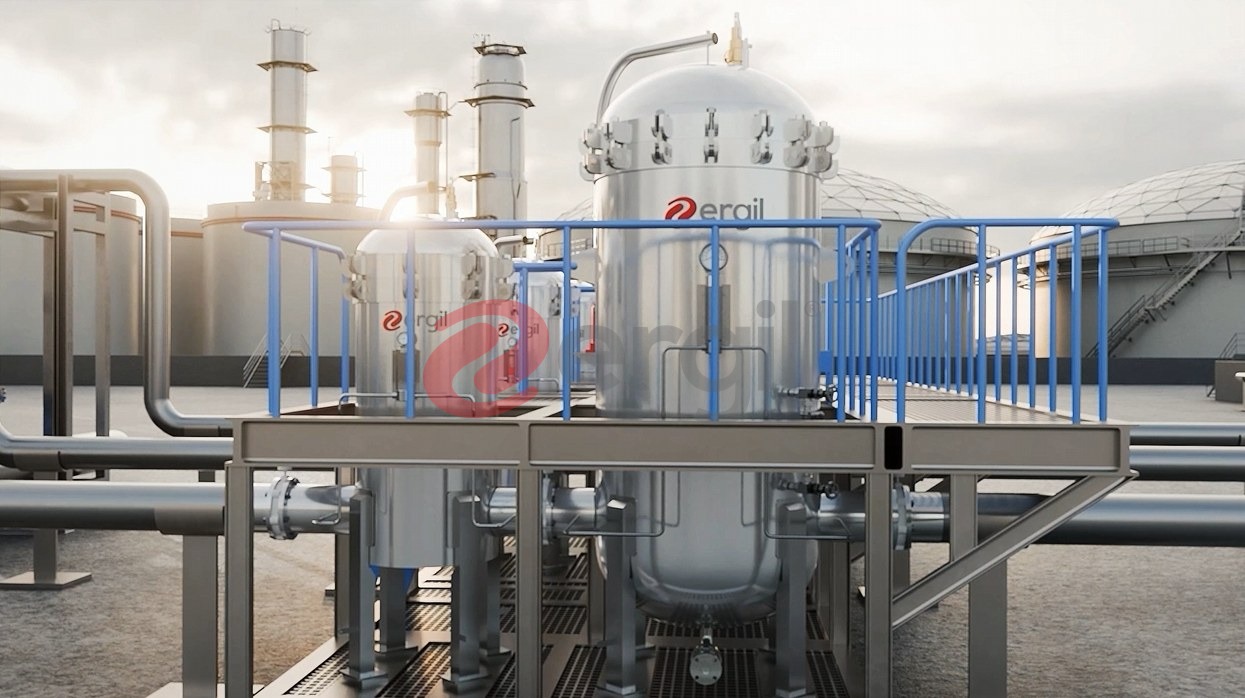
ERGIL skid-mounted, modular process package — shop-fabricated, pre-tested and delivered as an integrated module.
Aviation is entering an unprecedented industrial scale-up. To meet binding Sustainable Aviation Fuel (SAF) mandates, the industry must move rapidly from pilot and early-commercial plants to large-scale deployment. Yet while feedstock chemistry dominates the headlines, most SAF projects are won or lost on a more practical question: can the facility be executed on schedule, at cost, while managing severe-service materials and process complexity?
This article looks at SAF from the equipment side — the treatment, filtration and separation systems a SAF plant actually needs, the standards and materials behind them, and why modular, shop-fabricated packages are becoming a strategic enabler of fast-track SAF delivery. It closes with where ERGIL’s fabricated-systems capability fits.
From Ambition to Implementation: the SAF Demand Floor
SAF is no longer discretionary. Under the EU’s ReFuelEU Aviation regulation, fuel suppliers must blend a minimum share of SAF into jet fuel at EU airports — starting at 2% in 2025 and rising in steps to 70% by 2050, with a dedicated sub-mandate for synthetic e-fuels. The UK operates its own SAF Mandate (2% in 2025 to 22% by 2040), Switzerland is aligning with the EU, and Türkiye is developing dedicated SAF regulations. These mandates create something unusual in energy markets: a hard, legally backed, rising demand floor.
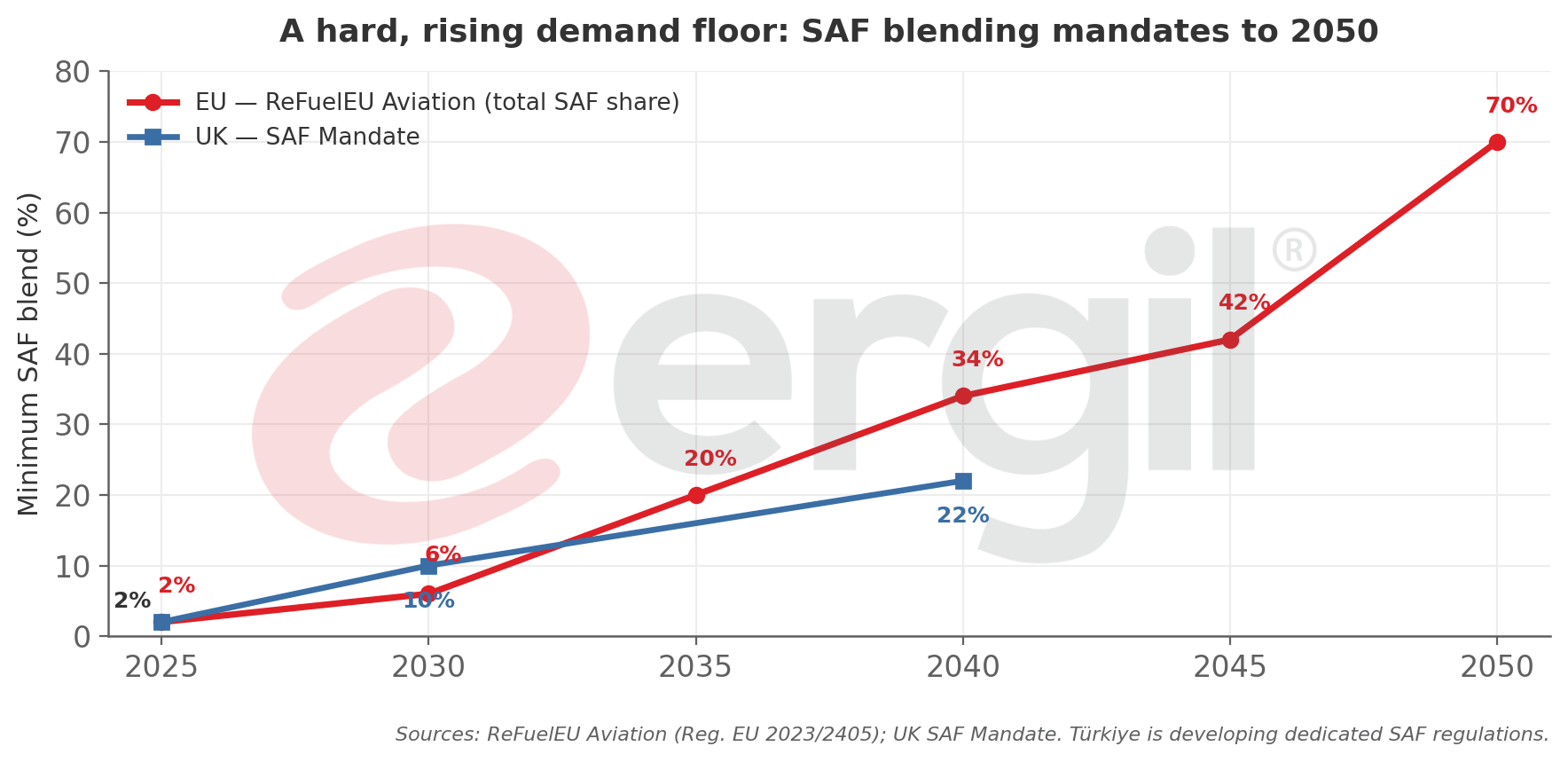
Binding blending mandates give SAF a rising demand floor to 2050 — the question is execution capacity, not demand.
Energy security is now part of the case
The commercial logic for SAF has always rested on decarbonisation and mandate compliance. In 2026 a second driver moved to the foreground. The disruption to Gulf oil flows — with a substantial share of seaborne crude and products affected and price volatility across refined fuels — has been characterised by the International Energy Agency as the largest supply disruption in the history of the global oil market, with effects expected to persist into 2027. SAF is produced from diverse, largely domestic or regional feedstocks — waste fats, oils and greases, residues, and eventually e-fuels — so scaling it also diversifies fuel supply away from a small number of geographic chokepoints. For governments and airlines alike, energy security has become a reason to accelerate, not defer, SAF investment.
The SAF Pathways — and Why Equipment Differs
«SAF» covers several production routes, each ASTM D7566-approved for blending with conventional Jet A-1. They impose very different equipment, materials and treatment requirements — which is exactly why a one-size package does not exist.
| Pathway | Feedstock | Maturity | Key equipment implications |
|---|---|---|---|
| HEFA | Waste fats, oils, greases; vegetable oils | Most mature — dominant today | Heavy feedstock pretreatment & filtration; hydrogen-service vessels; sour-water & acid-gas treatment |
| AtJ (Alcohol-to-Jet) | Ethanol / isobutanol | Commercialising | Dehydration, oligomerisation, hydrotreating; process skids |
| FT (Fischer-Tropsch) | Biomass / MSW / captured CO₂ (via syngas) | Emerging at scale | Gas cleaning, syngas conditioning, severe-service vessels |
| PtL / e-fuels | Green H₂ + captured CO₂ | Early — mandated from 2030 | Electrolysis balance-of-plant, CO₂ handling, synthesis modules |
Because Hydrotreated Esters and Fatty Acids (HEFA) is the most mature route and the basis of most projects reaching final investment decision today, the remainder of this article focuses there — but the modular-execution logic applies across all pathways.
The Treatment & Filtration Systems Inside a SAF Plant
Processing waste fats, oils and greases is nothing like processing clean crude fractions. The feed carries solids, water, gums, phosphorus, metals and other impurities that foul catalysts and destroy reliability if they are not removed first. As a result, filtration, separation and treatment are mission-critical process systems in a SAF plant — not auxiliary items. The diagram below maps where they sit, and where ERGIL fabricates equipment.
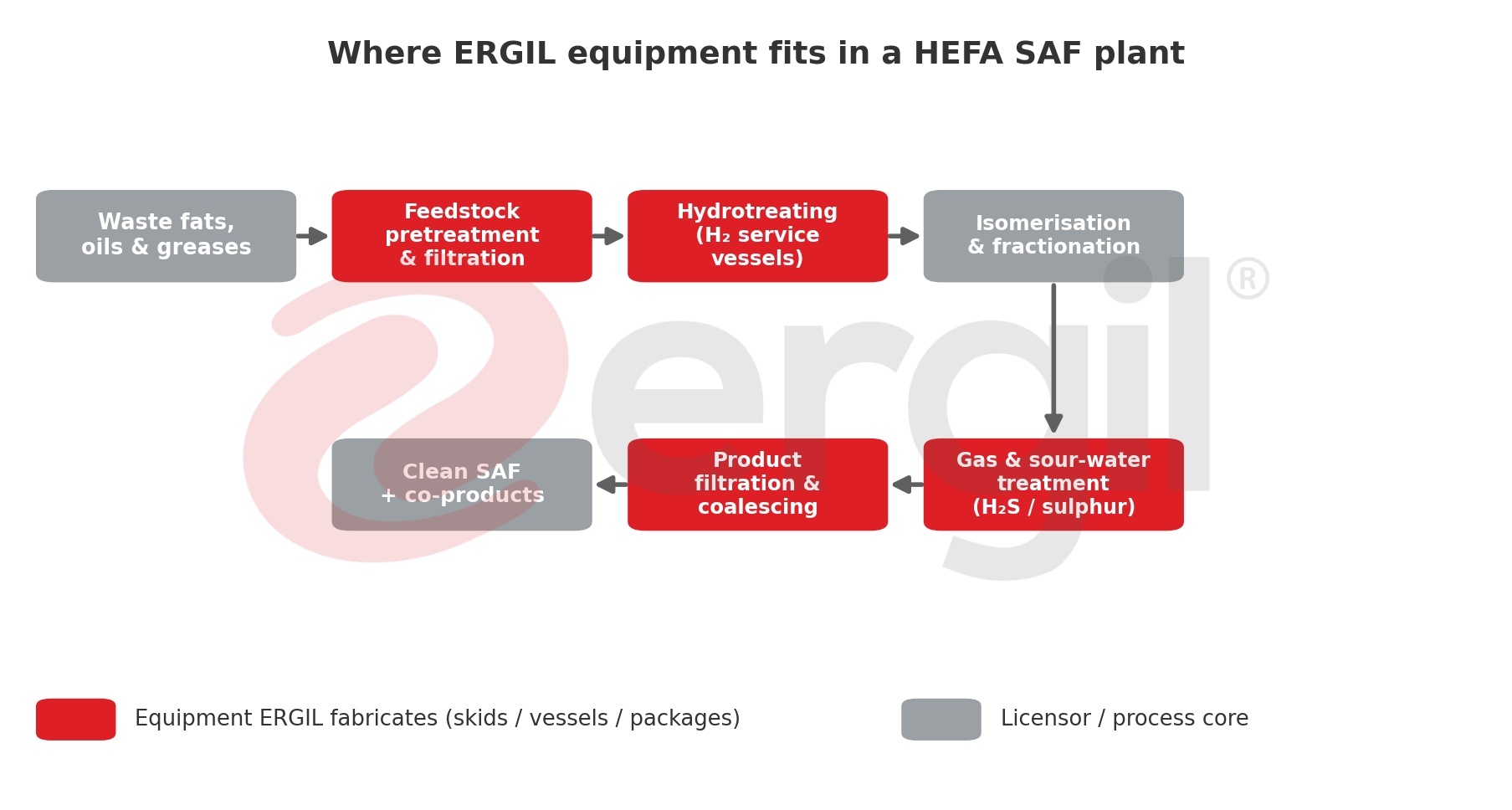
A HEFA SAF plant is a chain of treatment steps. ERGIL fabricates the filtration, separation, vessel and treatment packages around the licensor’s process core.
1 · Feedstock pretreatment & filtration
The first line of defence. Waste-derived feedstocks must be de-watered, de-gummed and cleaned of solids, phosphorus and metals before hydrotreating. Engineered as an integrated pretreatment skid — filters, separators, coalescers, piping, valving and instrumentation on a single module — this stage protects the catalyst and the economics of the whole plant. Treating it as an afterthought is one of the most common causes of early-life reliability problems.
2 · Hydrogen-service reaction & vessels
HEFA is hydrogen-intensive: triglycerides are hydrotreated and isomerised under hydrogen-rich, elevated-temperature, high-pressure conditions. That drives demanding pressure-vessel duty and materials selection — often chromium-molybdenum alloys for hydrogen service and NACE-compliant solutions for wet-H₂S environments, all under ASME, API and PED. Here, mechanical integrity is a process-reliability issue, not merely a compliance box.
3 · Gas & sour-water treatment (H₂S / sulphur removal)
Hydroprocessing liberates sulphur as hydrogen sulphide, which reports to gas and water streams. SAF plants therefore need sour-water treatment and acid-gas / sulphur-removal systems. A common, robust solution for H₂S removal is a fixed-bed adsorbent vessel: the process licensor or media supplier provides the adsorbent, and the fabricator delivers the code-compliant vessels — internals such as fixed bed supports, gratings, distributors and vortex breakers, manways sized to load the media, and materials selected for sour service (NACE MR0103) with clad or stainless nozzles as required. This is precisely the kind of severe-service vessel-plus-internals scope ERGIL fabricates.
4 · Product fuel-quality: filtration & coalescing
Finished SAF must meet the same clean, dry, water-free jet-fuel quality as conventional Jet A-1 before it can be blended and delivered. That means the same discipline covered in our companion article on aviation fuel filtration — micro filters, filter/separators (coalescer + separator) and, where needed, clay treaters, all in ASME-compliant housings — applied at the product end of the SAF plant.
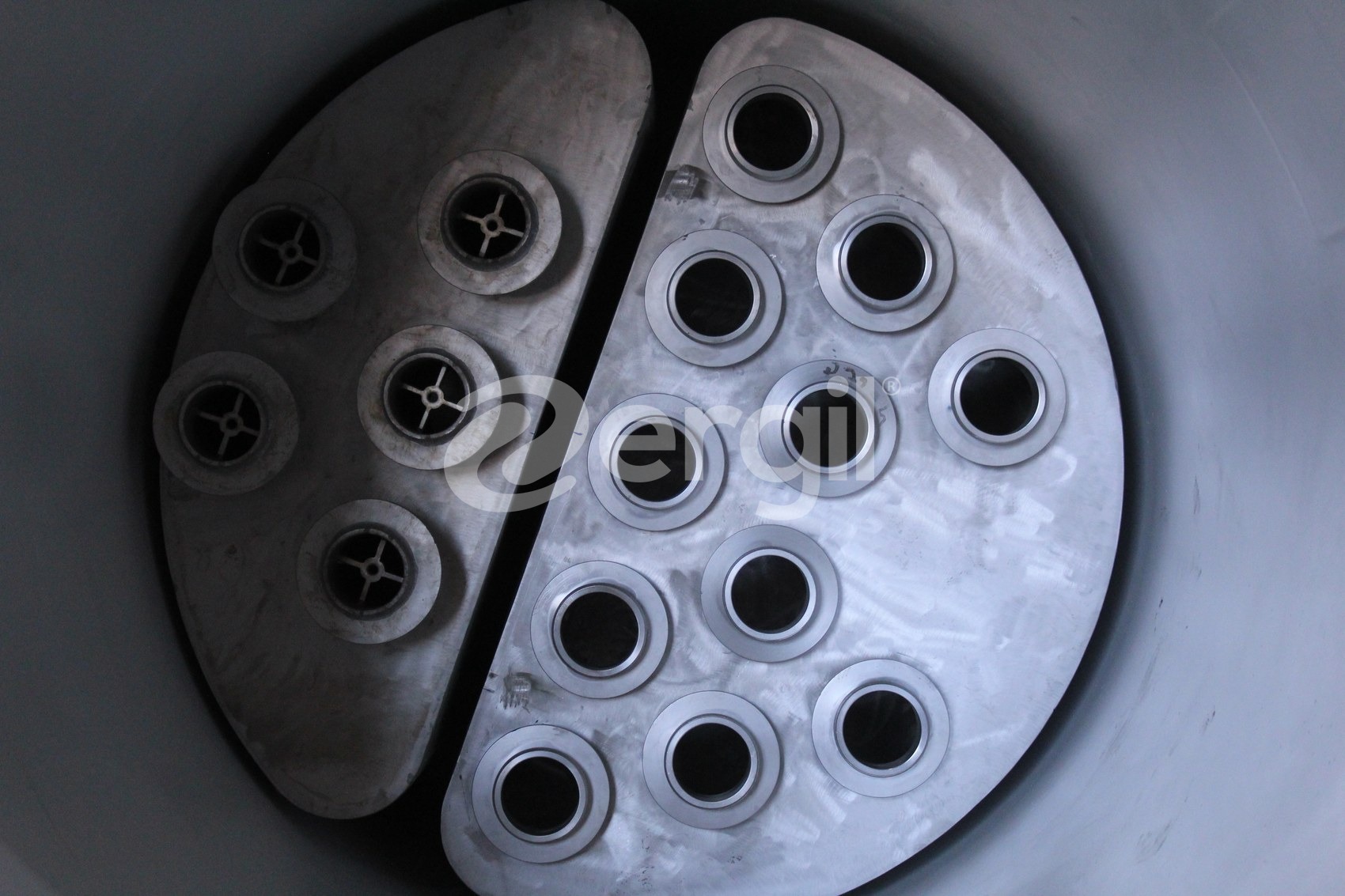
Coalescer/separator internal arrangement — the fuel-quality assurance stage that finished SAF shares with conventional jet fuel.
5 · Utility & balance-of-plant modules
Around the process core sit utility and balance-of-plant systems — many of which are ideal modularisation candidates, pre-assembled and tested in the shop and dropped into the plant as complete packages.
Standards & Materials for Severe SAF Service
SAF equipment sits at the intersection of demanding materials and code compliance. Specifying it correctly is what separates a reliable plant from a reliability liability.
| Requirement | Where it applies | Typical basis |
|---|---|---|
| Hydrogen-service alloys | Hydrotreating / isomerisation vessels | Cr-Mo steels; hydrogen-service design |
| Sour-service materials | Wet-H₂S vessels, sour-water, adsorbers | NACE MR0103 / MR0175 |
| Pressure-vessel code | All pressure-retaining equipment | ASME Sec VIII · API · PED (2014/68/EU) |
| Material certification | Pressure vs. non-pressure parts | EN 10204 3.1 / 2.2 |
| Fuel-quality filtration | Product SAF filter/separators | Energy Institute EI 1581 / EI 1590 |
| Fabrication & NDE | Welding, inspection, testing | Qualified WPS; RT/UT; hydrotest |
Modular Execution as a Strategic Advantage
For many SAF projects, schedule risk is as critical as technology risk. Traditional stick-built construction introduces schedule uncertainty, labour bottlenecks and field-quality risk. Modularisation changes the execution model: it lets civil works and fabrication proceed in parallel and moves complexity out of the field and into a controlled manufacturing environment.
| Advantage | What it delivers for a SAF project |
|---|---|
| Improved quality & reliability | Controlled shop fabrication supports tighter QA/QC, better weld quality, disciplined materials control and more reliable testing than field assembly. |
| Reduced schedule risk | Pre-assembled, pre-tested skids cut field-installation duration and shield the project from labour shortages and weather delays. |
| Lower total installed cost | Less field labour, lower construction risk and simpler interfaces improve project economics. |
| Reduced EPC interface risk | Integrated packages cut coordination complexity across vendors and disciplines — an underappreciated source of delay. |
Particularly in brownfield refinery conversions — where many SAF projects are emerging — modular retrofit packages significantly reduce tie-in risk and plant downtime.
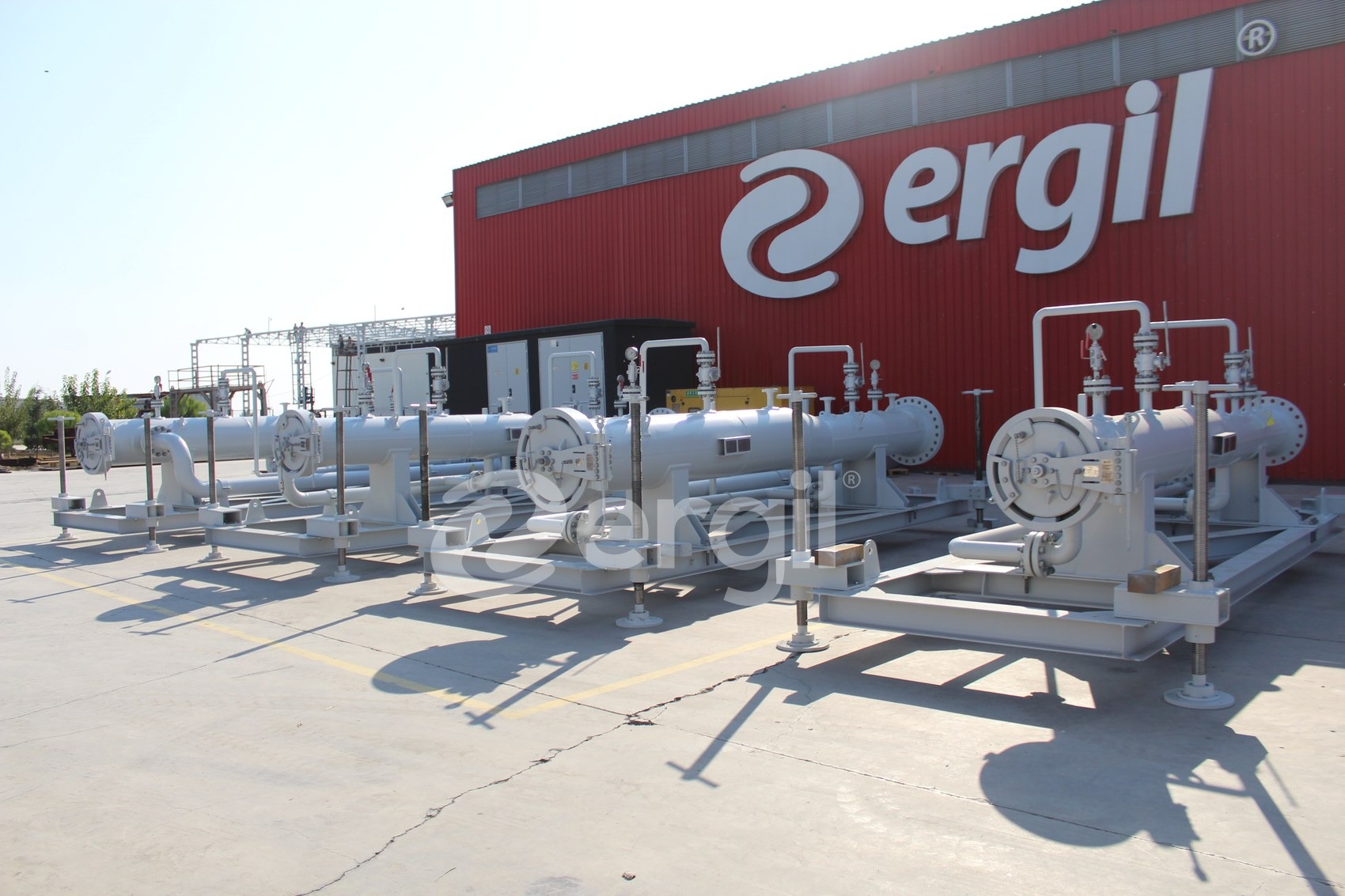
Shop-fabricated, adjustable skid-mounted packages — the modular execution model that fast-tracks SAF delivery.
Where ERGIL Fits: A Fabricated-Systems Partner for SAF
As the industry scales, success will depend not only on licensors and process technology, but on capable manufacturing partners able to deliver critical infrastructure rapidly and reliably. With decades of experience in engineered fabrication and modular systems, ERGIL supports SAF developers, EPCs and licensors as a fabricated-systems partner — not merely an equipment supplier.
Potential SAF scope
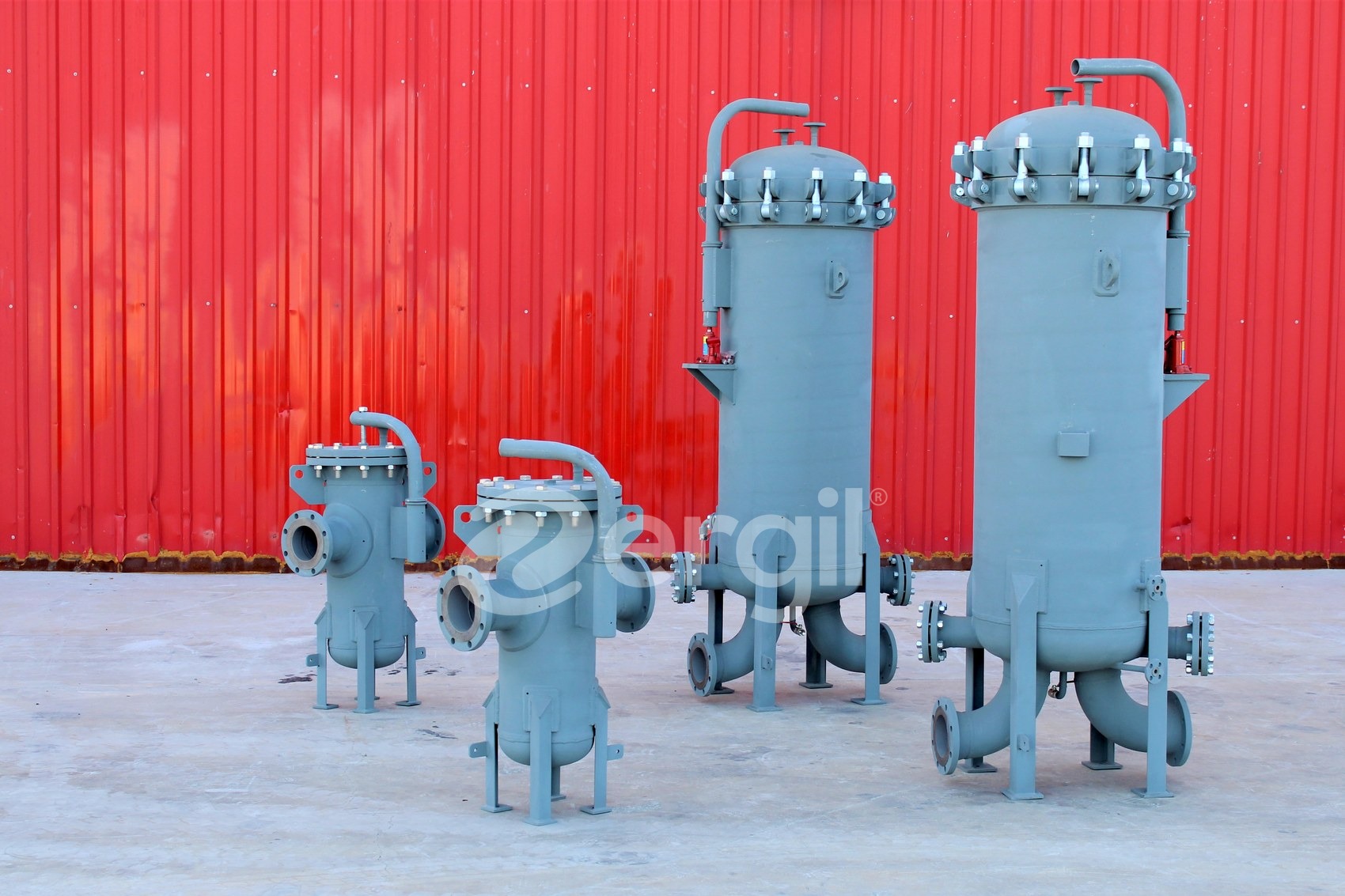
ERGIL filtration, separation and vessel equipment across a range of duties and capacities.
Conclusion
Scaling Sustainable Aviation Fuel requires more than breakthrough chemistry. It requires practical engineering that reduces risk, improves reliability and accelerates delivery. By combining modular process equipment, integrated filtration and separation packages, severe-service vessel expertise and fabricated-systems execution, SAF developers can navigate the industrial realities of scale-up — while binding mandates and a sharpened energy-security case make that scale-up urgent.
As the SAF market moves from ambition to implementation, modularisation may prove not just a construction strategy, but one of the industry’s most important deployment accelerators — and ERGIL is positioned to build the filtration, treatment and vessel systems at its core.