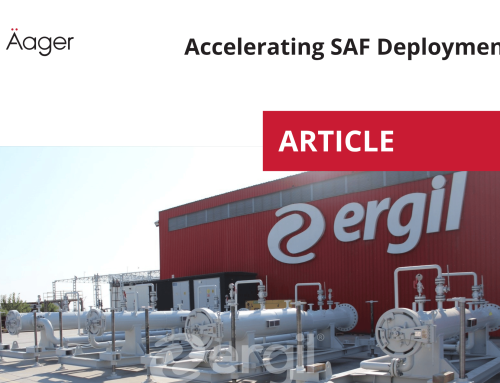
Accelerating SAF Deployment Through Modular Process Equipment and Fabricated Systems
Mitigating Technical Risk and Fast-Tracking Sustainable Aviation Fuel Projects
The aviation sector faces an unprecedented industrial scale-up. To achieve ambitious Sustainable Aviation Fuel (SAF) targets, the industry must rapidly move from pilot and early commercial facilities toward large-scale deployment. Yet while chemistry and feedstock pathways often dominate discussion, many SAF projects face a more practical challenge: executing reliable facilities on schedule while managing process complexity, materials risks and tight capital budgets.
For refinery owners, EPCs and technology licensors, traditional stick-built construction can introduce schedule uncertainty, labor bottlenecks and quality risks. As a result, modular process equipment and fabricated packaged systems are becoming strategic enablers for SAF deployment.
In this environment, companies capable of combining process understanding with advanced fabrication and materials selection expertise can play an increasingly critical role.
Conquering Feedstock Variability with Integrated Pretreatment Systems
Among today’s SAF pathways, Hydrotreated Esters and Fatty Acids (HEFA) remains the most mature. But processing waste fats, oils and greases introduces challenges very different from conventional hydrocarbon streams.
Feedstock impurities — solids, water, metals and gums — can cause catalyst fouling, reliability problems and costly shutdowns if not properly managed.
This makes filtration, separation and pretreatment systems mission-critical, not auxiliary.
Rather than treating these as isolated components, a modular approach allows these functions to be engineered as integrated packages. Pretreatment filtration skids incorporating filters, separators, piping, valving and instrumentation can improve process alignment while reducing field assembly complexity.
This is an area where ERGIL’s capabilities in skid-mounted and modular process equipment can support SAF developers, including potential supply of:
- Pretreatment filtration skids
- Separator and coalescer packages
- Filter/coalescer packages for fuel quality assurance
- Utility and balance-of-plant modules
- Hydrogen service pressure vessels
- Modular process packages for greenfield and retrofit SAF projects
Particularly in brownfield refinery conversions—where many SAF projects are emerging—modular retrofit packages can significantly reduce tie-in risk and project downtime.
Materials Selection for High-Severity Hydroprocessing
SAF production frequently involves severe operating conditions: hydrogen-rich environments, elevated temperatures, corrosive service and demanding pressure vessel duty.
These services often require:
- Chromium-molybdenum alloys for hydrogen service
- NACE-compliant material solutions
- High-integrity pressure vessel fabrication under ASME, API and PED
- Specialized coalescer and separator designs for fuel quality assurance
In such applications, mechanical integrity is not simply a compliance issue — it is a process reliability issue.
ERGIL’s experience in code-compliant pressure vessels, separation equipment and specialized fabricated systems can help address these requirements, particularly where modular execution must be combined with demanding materials requirements and severe-service design.
For fouling-prone feedstocks and hydrogen-intensive services, this integration of process equipment and fabrication expertise becomes especially valuable.
Modular Execution as a Strategic Advantage
For many SAF projects, schedule risk may be as critical as technology risk.
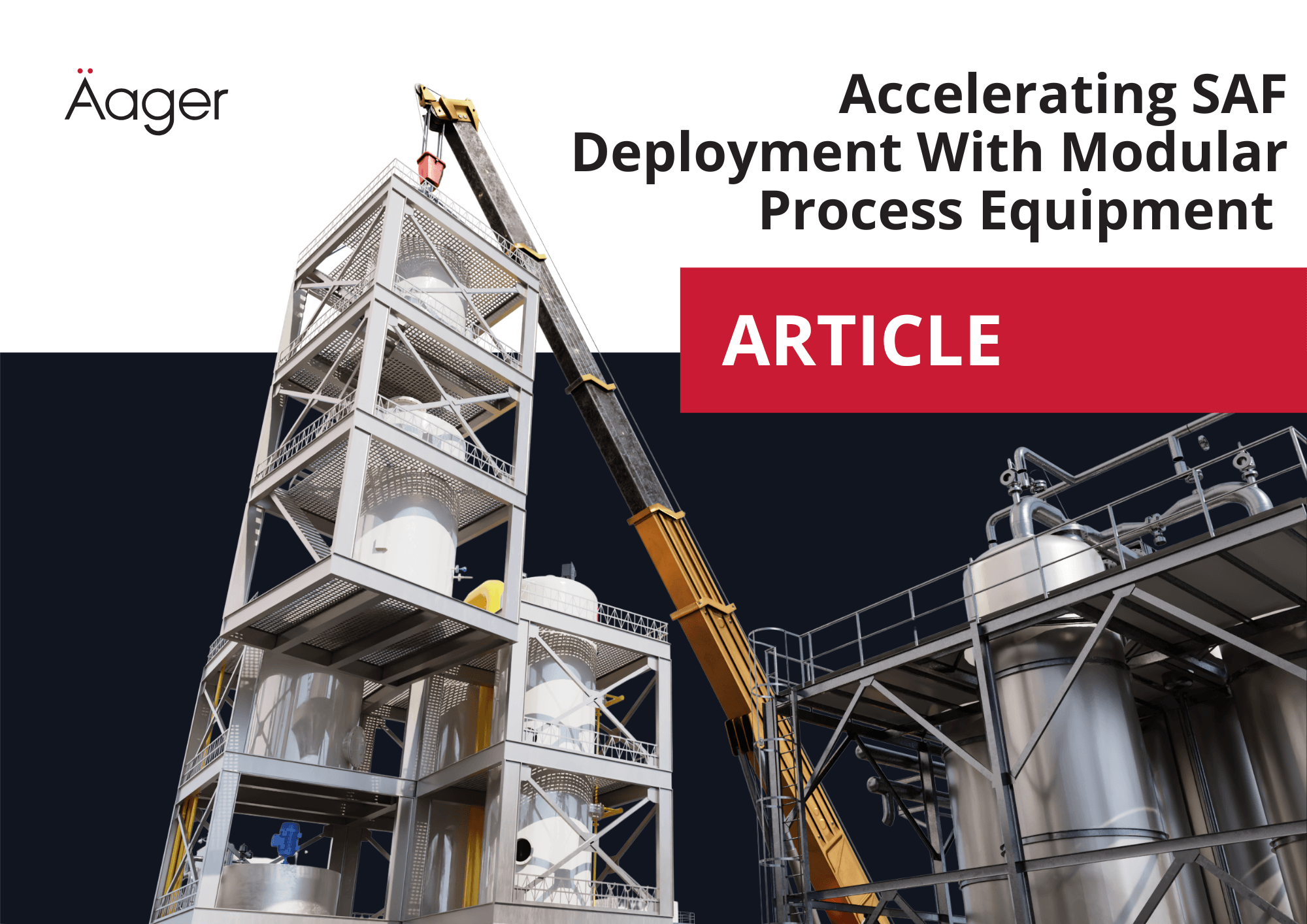
Modularization changes the execution model by allowing civil works and fabrication to proceed in parallel while moving complexity from site into controlled manufacturing environments.
Improved Quality and Reliability — Controlled shop fabrication supports tighter QA/QC, improved weld quality, better materials control and more reliable testing than field assembly alone.
Reduced Schedule Risk — Pre-assembled skids and packaged systems reduce field installation duration and shield projects from labor shortages and weather-driven delays.
Lower Total Installed Cost — Reduced field labor, lower construction risk and simplified interfaces can improve project economics.
Reduced EPC Interface Risk — Integrated packaged systems can reduce coordination complexity across multiple vendors and disciplines—often an underappreciated source of project delays.
For fast-track SAF deployment, these advantages can be decisive.
Manufacturing as an Enabler of SAF Scale-Up
As the industry scales, success will depend not only on licensors and process technology, but also on capable manufacturing partners able to deliver critical infrastructure rapidly and reliably.
This is where modular fabrication, code compliance and packaged process equipment move from procurement items to strategic project tools.
With decades of experience in engineered fabrication and modular systems manufacturing, ERGIL supports project developers seeking lower-risk and faster-track execution.
With capabilities spanning filtration, separation, coalescers, pressure vessels and modular process systems, ERGIL can support this shift not merely as an equipment supplier, but as a fabricated systems partner contributing to faster, lower-risk SAF execution.
Conclusion
Scaling Sustainable Aviation Fuel requires more than breakthrough chemistry. It requires practical engineering solutions that reduce risk, improve reliability and accelerate project delivery.
By leveraging modular process equipment, integrated filtration and separation packages, severe-service vessel expertise and fabricated systems execution, SAF developers can better navigate the industrial realities of scale-up.
As the SAF market moves from ambition to implementation, modularization may prove not just a construction strategy—but one of the industry’s most important deployment accelerators.